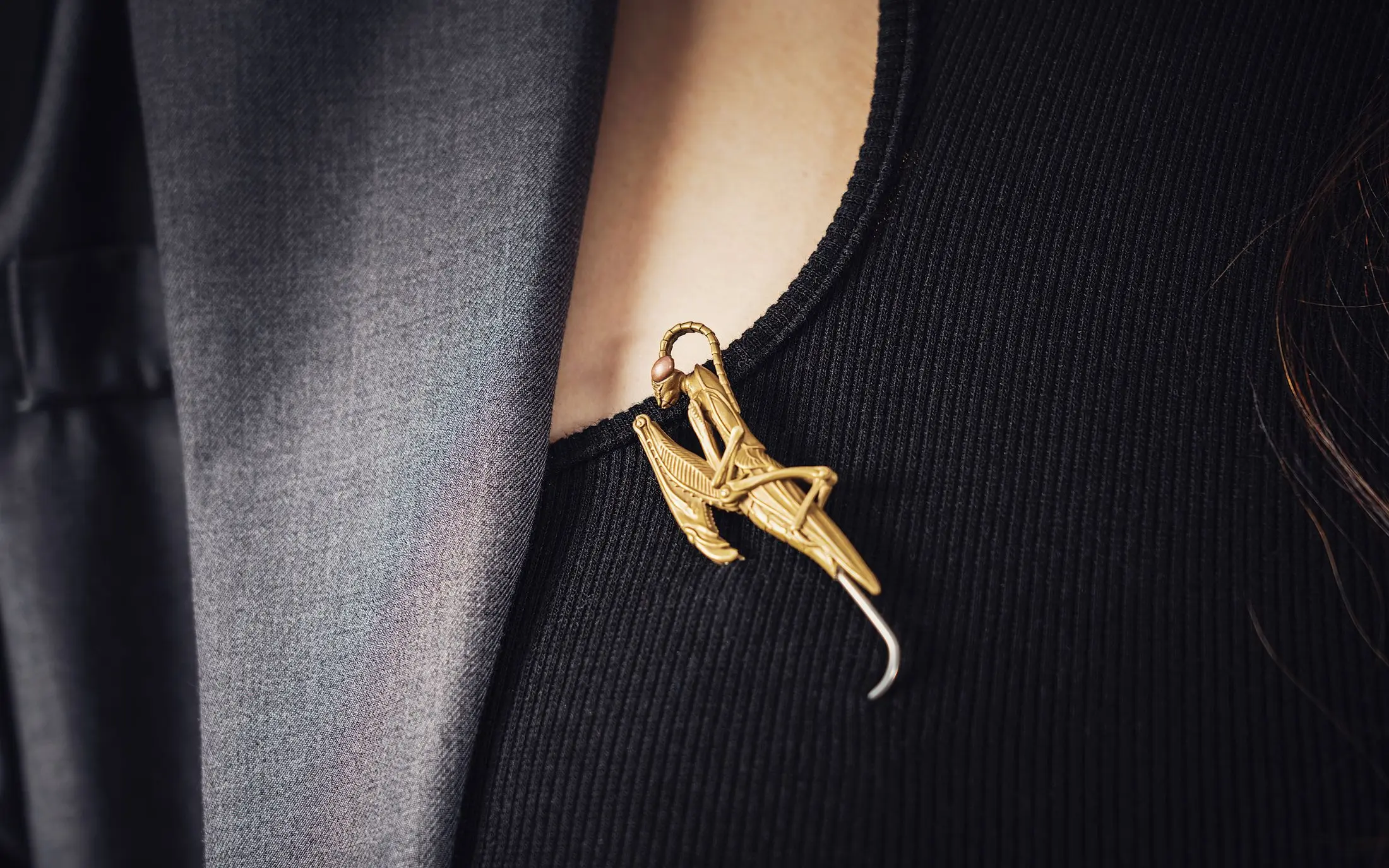
The brooch revival is not simple nostalgia. At a moment when clothes move between minimalism, uniformity and the fast image of social media, a brooch creates a small but forceful point of difference—an object whose position and meaning can be changed by its owner every day.
Signals of a comeback: autumn 2026 runways to the red carpet
British Vogue identified brooches as a clear autumn/winter 2026 runway signal, from Armani and Ralph Lauren to Conner Ives, Tory Burch and Simone Rocha. The significant change was not only volume but placement: off the lapel, onto knitwear and unexpected parts of the body, sometimes in clusters.
At the 2026 Oscars, menswear jewellery moved decisively beyond watches and cufflinks. Damson Idris wore a custom blue-diamond brooch referencing Formula One; Joe Alwyn, Kieran Culkin and Pedro Pascal took different routes from classic pin to textile and feather-like forms. Cinema is not the cause of the trend. It is its largest public display.
These figures come from Pinterest Predicts 2026. They describe platform search growth, not global sales. Yet the convergence of search, runway and awards-season dressing is meaningful: audiences are interested again in jewellery that tells a story on clothing.
Why now? The brooch sits at the crossing of several movements
First, men’s jewellery is expanding, and a brooch offers entry without piercing or sizing. Second, heirloom pieces are returning to use. Third, high gold prices reward smaller objects with a high proportion of design value. Fourth, a brooch reads in a full-length photograph—a distinct advantage in contemporary fashion.
It also suits the demand for personal styling. A necklace generally has one territory and a ring one finger; a brooch can sit on lapel, shoulder, waist, tie, bag, hat or shoe. Placement gives part of the final composition to the wearer.
A brooch is not simply worn. It is curated again each time.
Jewellery released from the body—and from gender
The most compelling feature of the 2026 return is the erosion of “women’s” and “men’s” boundaries. The same piece can sit on formal tailoring, a T-shirt, a contemporary robe or a bag. Meaning comes from design and styling, not a gendered retail shelf.
This freedom is both opportunity and test. A large logo or historical imitation may become a seasonal accessory. A lasting piece needs a silhouette from a distance, detail up close, a resolved back and a reliable mechanism.
Identity marker
Introduces a form, letter, creature or memory without demanding ornate clothing.
Movable object
Lets the wearer change both placement and composition.
Active inheritance
Brings older pieces out of storage and into daily life.
Beyond gender
Defined on the garment, with fewer size and category constraints.
Anatomy of a good brooch: beauty is not enough
A brooch negotiates gravity. If its centre of mass sits too far from the pin, it rotates or drags the fabric. A weak clasp can lose a valuable object in one movement. A rough back or oversized needle damages clothing. And if only the front has been designed, the moment of fastening reveals the truth.
Weight balance
Pin axis, centre of gravity and fabric resistance must be tested together.
Secure fastening
It should close with one hand without opening accidentally.
A designed back
Backplate, edges and soldering are part of quality, not a forgotten zone.
Real transformability
Pendant or hair-jewel modes matter only when each is technically complete.
The Iranian opportunity: a small narrative, not decorative cliché
Iran’s visual culture offers rich material: calligraphy, seals, architecture, gardens, mythic animals, ecology, metalwork and urban memory. Directly lifting a historical motif does not automatically create contemporary design. The opportunity lies in translation—a proportion, rhythm or story that addresses the present without becoming souvenir.
The commercial format is equally useful. A brooch can be limited edition, bespoke commemoration or collaboration between fashion designer and jeweller. For a brand confronting high gold prices, its small surface allows more value to come from idea, craft and mechanism—the move from weight to design.
If familiar historical motifs were unavailable, which lived experience of Iran today would deserve to become a wearable sign?
Frequently asked questions
Are brooches really a major trend in 2026?
Yes. Their visibility across autumn/winter 2026 collections and awards-season dressing, together with rising related Pinterest searches, provides three distinct signals.
Are brooches only for formal or womenswear?
No. In 2026 they appear on menswear, shirts, knitwear, bags and in clusters. Freedom of placement and gender is central to the revival.
What makes a brooch well designed?
Weight balance, a secure fastening, fabric protection, a resolved back, distance legibility and transformability all matter.
What is the opportunity for Iranian designers?
To translate Iranian narrative, calligraphy, architecture, nature and metalwork into small contemporary objects without defaulting to decorative cliché or historical imitation.
Numerical claims link to primary material or reputable reporting. U.S. and European data are not presented as Iranian market statistics, and early research prototypes are separated from commercial and medical devices.