The World Gold Council reports that technology used 80.4 tonnes of gold in the second quarter of 2026, 2% more than a year earlier. Electronics, at 68.3 tonnes and up 4%, led that rise, with AI infrastructure named as one supporting factor. “One” matters: the data do not issue a separate gold bill for artificial intelligence.
What does the new number actually say?
The 30 July 2026 report defines technology as electronics, other industrial applications and dentistry. Total use was 80.4 tonnes, of which electronics consumed 68.3 tonnes. The World Gold Council places growth in servers, high-end semiconductors and advanced AI components alongside weakness in smartphones and laptops.
It does not publish an AI-only tonnage. Claims that AI consumed all 80 tonnes, or caused all growth, exceed the evidence. Technology was also a relatively small part of total quarterly demand of 1,269 tonnes including OTC, so it cannot be treated as the sole driver of the global gold market.
Why does a computing machine need gold?
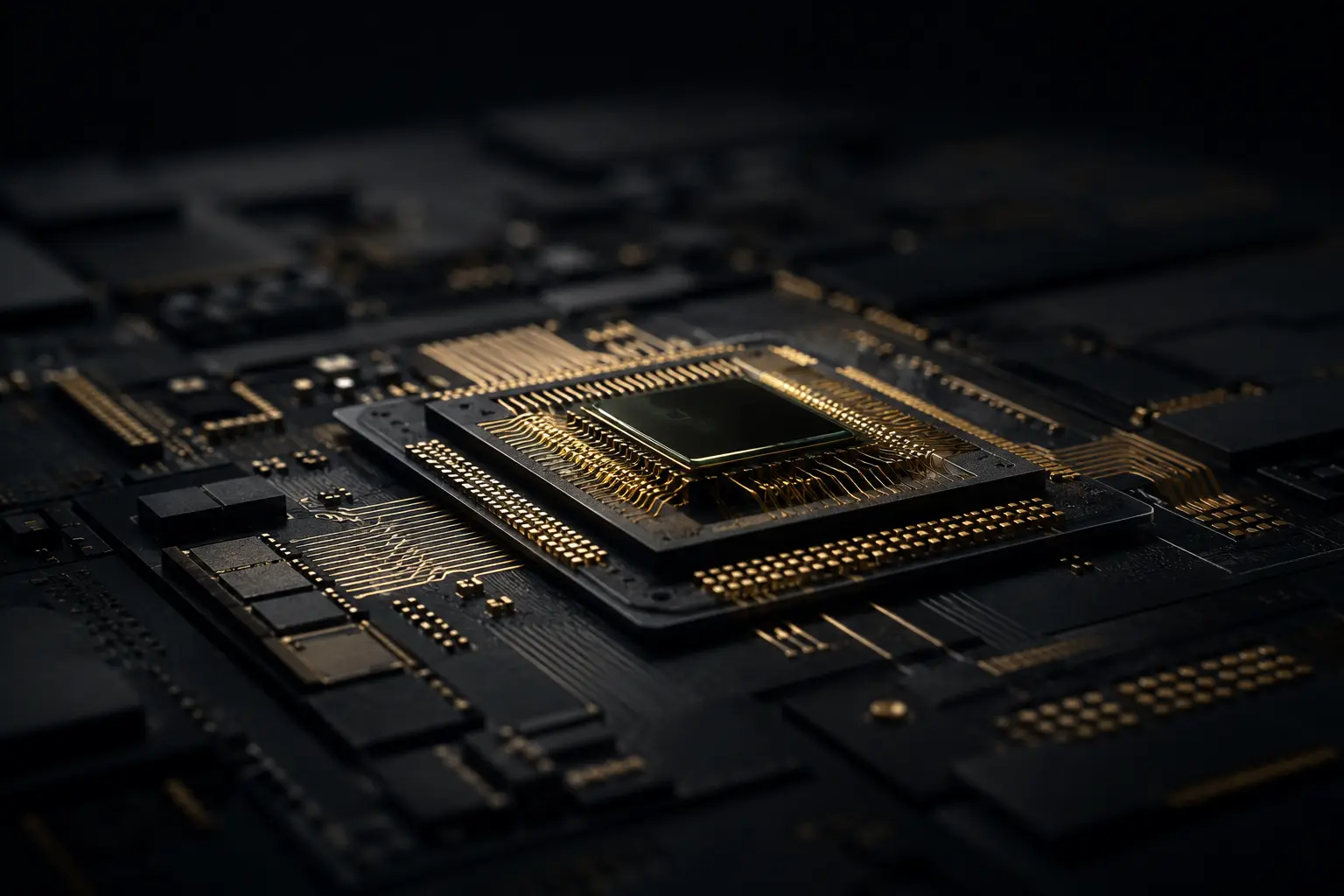
Gold conducts well, resists corrosion and offers reliability in contacts, connectors, coatings and some extremely fine bonds. Each server component uses very little. At the scale of accelerators, memory, networking and data-centre equipment, those minute layers accumulate.
Growth at the highest end of computing does not translate evenly across every device. Manufacturers simultaneously thin gold, substitute other materials and remove it from lower-risk functions. Gold remains where the cost of failure outweighs material savings.
Gold in AI infrastructure is invisible, but it serves precisely where invisible failure is expensive.
Durable growth or an investment wave?
TSMC's second-quarter results show high-performance computing continuing to support demand for advanced semiconductors. That industrial signal fits the World Gold Council's account: the build-out of AI capacity is currently supporting some technical uses of gold.
The WGC outlook nevertheless warns that broad electronics weakness and disappointment in returns on AI investment could reduce that support. Data-centre ordering is cyclical; one strong quarter is not a straight line forever. A sound view tracks both capacity expansion and continuing thrifting and substitution.
What does this have to do with jewellery?
Jewellery and technology use the same metal under different value systems. In a chip, gold must perform and be minimised; in jewellery it is seen, worn, repaired and narrated. As gold becomes more expensive, both industries reduce weight—one through contact engineering, the other through volume, hollow construction and controlled making.
Direct competition between technology and jewellery should not be exaggerated because technology's share of total demand remains limited. The cultural shift is more interesting: a metal associated with ornament and stored value is also invisible infrastructure for the computing economy.
End of route: urban mine or complex waste?
At end of life, advanced servers and boards contain dispersed gold and other valuable metals. Responsible recovery requires controlled collection and separation, refining, worker safety, emissions control and residue management; informal or workshop recovery can be hazardous.
For a jewellery brand, electronic recycled gold is credible when material route, refiner, fineness and chain of evidence are clear. The story from server to jewel is persuasive; its documentation needs to be equally precise.
Frequently asked questions
Did AI itself consume exactly 80.4 tonnes of gold in Q2 2026?
No. 80.4 tonnes was total technology use and 68.3 tonnes was electronics. The report does not provide an AI-only tonnage.
What does gold do in servers and chips?
It appears in contacts, coatings, connectors and some fine bonds because of conductivity and corrosion resistance; the amount in each component is small.
Does AI growth determine the global gold price?
The evidence does not support that claim. Technology is one demand segment within a much larger market that includes investment, central banks, jewellery and recycling.
Historical, technical and regulatory facts were checked against official and primary sources. Vendor performance claims are attributed to their publishers and kept separate from editorial analysis. This is not legal, investment or environmental advice.