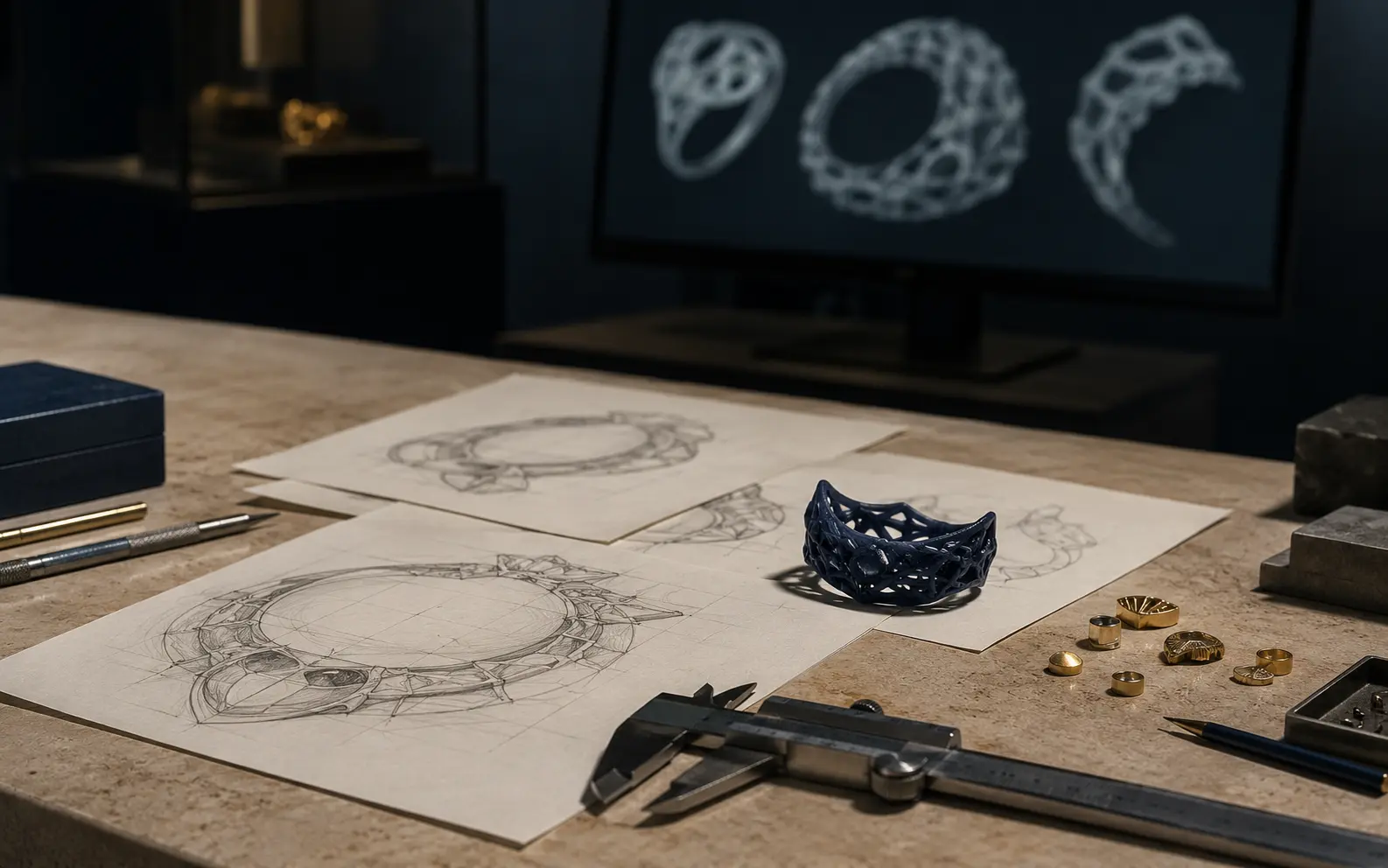
Professional education matters when a participant leaves with a different language for decisions: why this form, why this thickness, what will fail at the bench, and which revision can preserve the idea.
Why is DIDAR building masterclasses?
Jewellery does not suffer from a shortage of tutorials. It suffers from broken connections. Software is taught apart from making, design apart from product economics, and presentation apart from professional critique. The result may be seductive renders and complex files, but the knowledge gap appears as soon as weight, wall thickness, setting, casting or revision enters the conversation.
DIDAR Masterclass is designed for that gap: a focused room, a defined problem, a practitioner-teacher and an outcome that can be discussed precisely. The objective is not another certificate or a larger video library. It is to understand the tool in relation to body, material, workshop and market.
A tool creates speed. Professional judgement decides where that speed should go.
The first programme: Matrix 9 with Mobina Mohammadvali
DIDAR’s first programme is Matrix 9: Professional Jewellery CAD from Concept to Production with Mobina Mohammadvali. It starts with the fundamentals, has no prerequisite, and includes 20 three-hour sessions and 60 instructional hours. It runs on Sundays from 4:00 to 7:00 PM, has a capacity of 20 participants, and costs 55,000,000 toman per participant; the start date will be announced shortly.
Gemvision introduced Matrix 9.0 in April 2017. We do not conceal that history: Matrix 9 is now legacy software. The value of the programme must therefore extend beyond button locations; geometry, form, setting, surface modelling and production logic should become skills that outlast one interface.
Form
An idea must remain legible from several angles, on the body and at real scale.
Precision
Dimensions, symmetry, tolerance and connections must be chosen, not inherited from defaults.
Manufacturability
The model must survive casting, setting, finishing, assembly and future repair.
Critique
A participant must explain a choice, absorb feedback and construct a better version.
From watching to practising
Watching an expert use software can create an illusion of progress. The instructor’s hand is fast, the route looks clean and the final object appears complete. Learning starts when participants become stuck in their own files, diagnose the fault and understand which earlier decision must change.
That is why the format is project-led: concise demonstration, defined exercise, file critique, revision and presentation. Success is not measured only by resemblance to the teacher’s example. It is measured by whether a participant can reconstruct the reasoning in the next project.
A real design or production constraint, not a decorative exercise.
A deliberate tool choice and a version that can be inspected.
Clear identification of form, file and production errors.
A purposeful return to model history and earlier decisions.
Checks for scale, thickness, estimated weight and making route.
Explain choices and record the process for the next project.
Who is it for?
For a beginner who wants to start jewellery CAD with no prerequisite; for a jewellery designer seeking editable files that can support a serious workshop conversation; and for a maker who wants to understand CAD logic. The path progresses step by step towards accurate, manufacturable and production-ready modelling.
It is not designed for someone seeking only a quick certificate. A masterclass asks for concentration, work between sessions, willingness to receive critique and readiness to construct the same problem more than once.
A promise that stays precise
The interest form for Matrix 9 is open. It runs on Sundays from 4:00 to 7:00 PM, has a capacity of 20 participants, and costs 55,000,000 toman per participant. It includes 20 three-hour sessions, 60 instructional hours, and two projects in sessions 10 and 20. There is no prerequisite, and Rhino 5, Matrix 9, Magic and MatrixGold should be installed.
That clarity is part of the education. A manufacturable model cannot be built on guesswork and exaggeration; neither can a useful learning relationship. Future DIDAR programmes will cover jewellery design, making, technology, brand and business—each launched when its teacher, problem and output standard are ready.
Frequently asked questions
What is DIDAR’s first masterclass?
Matrix 9: Professional Jewellery CAD from Concept to Production with Mobina Mohammadvali, delivered in person and through a project-led format at DIDAR Space in Tehran.
When does the course run, and what are the capacity and tuition?
The course runs on Sundays from 4:00 to 7:00 PM, has a capacity of 20 participants, and costs 55,000,000 toman per participant. It includes 20 three-hour sessions and 60 instructional hours; the start date will be announced shortly.
Are DIDAR Masterclasses only software tutorials?
No. They connect tools with design judgement, manufacturability, workshop standards, presentation and professional critique.
Names appear only where they are relevant to the evidence and argument. The essay makes no ranking claim or unverified association and distinguishes official sources, editorial analysis and conceptual imagery.