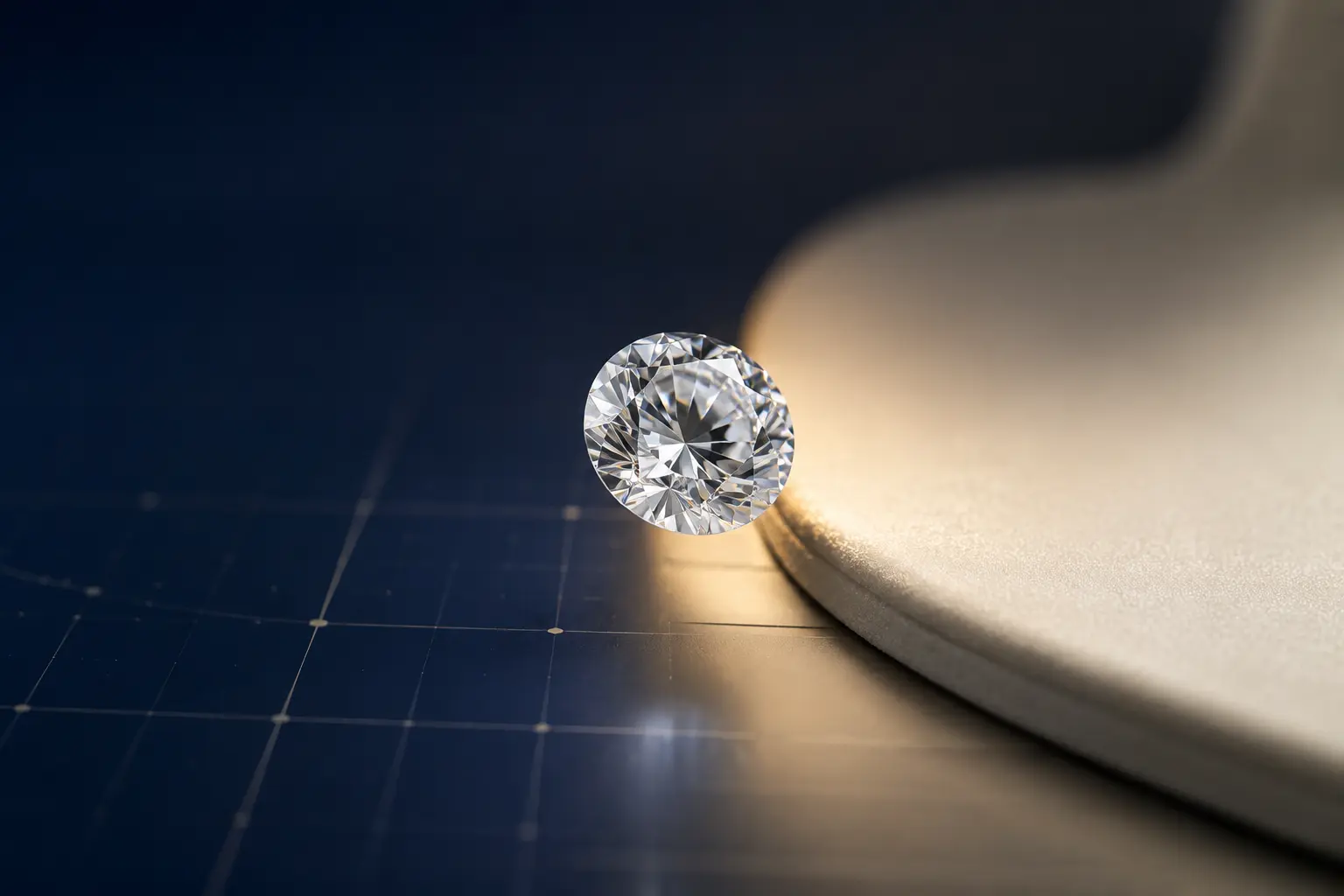
Since 1 October 2025, GIA has used two broad descriptions—Premium and Standard—for colourless to near-colourless laboratory-grown diamonds instead of the full natural-diamond colour and clarity language. The change does not say the product has no value. It says its logic of distinction is no longer identical to that of a natural stone.
What did GIA change?
GIA says more than 95 per cent of laboratory-grown diamonds entering the market occupy a very narrow range of colour and clarity. Under the new service, a D-to-Z stone meeting a combination of minimum colour, clarity, cut and finish criteria is Standard; a higher threshold earns Premium. Material below the Standard threshold does not receive the assessment.
This has not replaced the 4Cs for natural diamonds. Origin, formation time and scarcity remain different. A laboratory-grown diamond has essentially the same crystal structure and chemical composition as a natural diamond, and conclusive separation cannot be made reliably by unaided sight.
What does the shift say about the market?
HPHT and CVD technology can now produce larger, cleaner and more consistent stones. When high quality becomes repeatable at scale, fine grade differences carry less of a scarcity story. GIA has aligned its reporting language with the reality of industrial production.
De Beers' 2025 intention to close Lightbox offered another market signal. It linked the decision to substantial wholesale-price decline and renewed focus on natural diamonds. That is the position of an interested market participant, not a neutral verdict, but it reinforces why lab-grown diamonds should not be sold with an assumed natural-diamond value-retention story.
When the material becomes more abundant, value has to come from design, transparency and experience—not simulated scarcity.
Neither fake nor the same product
Two extreme claims are wrong at once. A laboratory-grown diamond is not glass or cubic zirconia; it possesses the core properties of diamond. It is also not natural, and its formation, supply and economics differ. Professional selling should communicate both facts without semantic games.
US FTC guidance says laboratory-grown or laboratory-created must clearly and conspicuously qualify diamond so buyers do not confuse it with a mined stone. Disclosure should remain consistent across advertising, sales conversation and invoice—not be buried in a report footnote.
The genuine design opportunity
Lower stone cost lets designers experiment with scale, colour or stone count. For fashion jewellery, statement work, custom design or an object whose present beauty is the main objective, that freedom is real. Setting, proportion, repairability and making quality remain decisive.
If many brands can source similar stones, advantage moves from specification to form, service, personalisation, narrative and honesty. A larger stone does not create a stronger brand; it can make weak design more visible.
A responsible buying and selling checklist
Laboratory origin should be explicit on the invoice. Check the laboratory record and laser inscription. Where documented, explain whether growth was HPHT or CVD, any post-growth treatment, and the seller's repair, exchange or buy-back policy. Do not present resale or investment claims without contractual evidence and credible data.
At workshop level, sight and a simple tester are not enough. GIA notes that conclusive origin identification can require combined gemmological evidence and advanced equipment. Any supply chain handling natural and laboratory-grown diamonds together needs robust separation, records and intake control.
Frequently asked questions
Is a laboratory-grown diamond a real diamond?
It has the crystal structure and core properties of diamond, but its origin is a factory or laboratory rather than natural geological formation. That difference must be disclosed.
What do Premium and Standard mean in GIA's new system?
They are descriptive categories for D-to-Z laboratory-grown diamonds based on combined colour, clarity, cut and finish thresholds. They do not replace natural-diamond grading.
Is a laboratory-grown diamond a good investment?
This article makes no such claim. Repeatable industrial supply and falling production costs can pressure price and resale; the purchase case should be use and design, not an unsupported promise of value retention.
Historical, technical and regulatory facts were checked against official and primary sources. Vendor performance claims are attributed to their publishers and kept separate from editorial analysis. This is not legal, investment or environmental advice.
- GIA — Updated laboratory-grown diamond services (26 August 2025)
- GIA — New descriptive terminology for laboratory-grown diamonds
- GIA — Laboratory-grown diamond identification update
- GIA — HPHT and CVD diamond growth processes
- De Beers Group — intention to close Lightbox (8 May 2025)
- US FTC — advertising diamonds, gemstones and pearls
- Responsible Jewellery Council — Laboratory Grown Material Standard