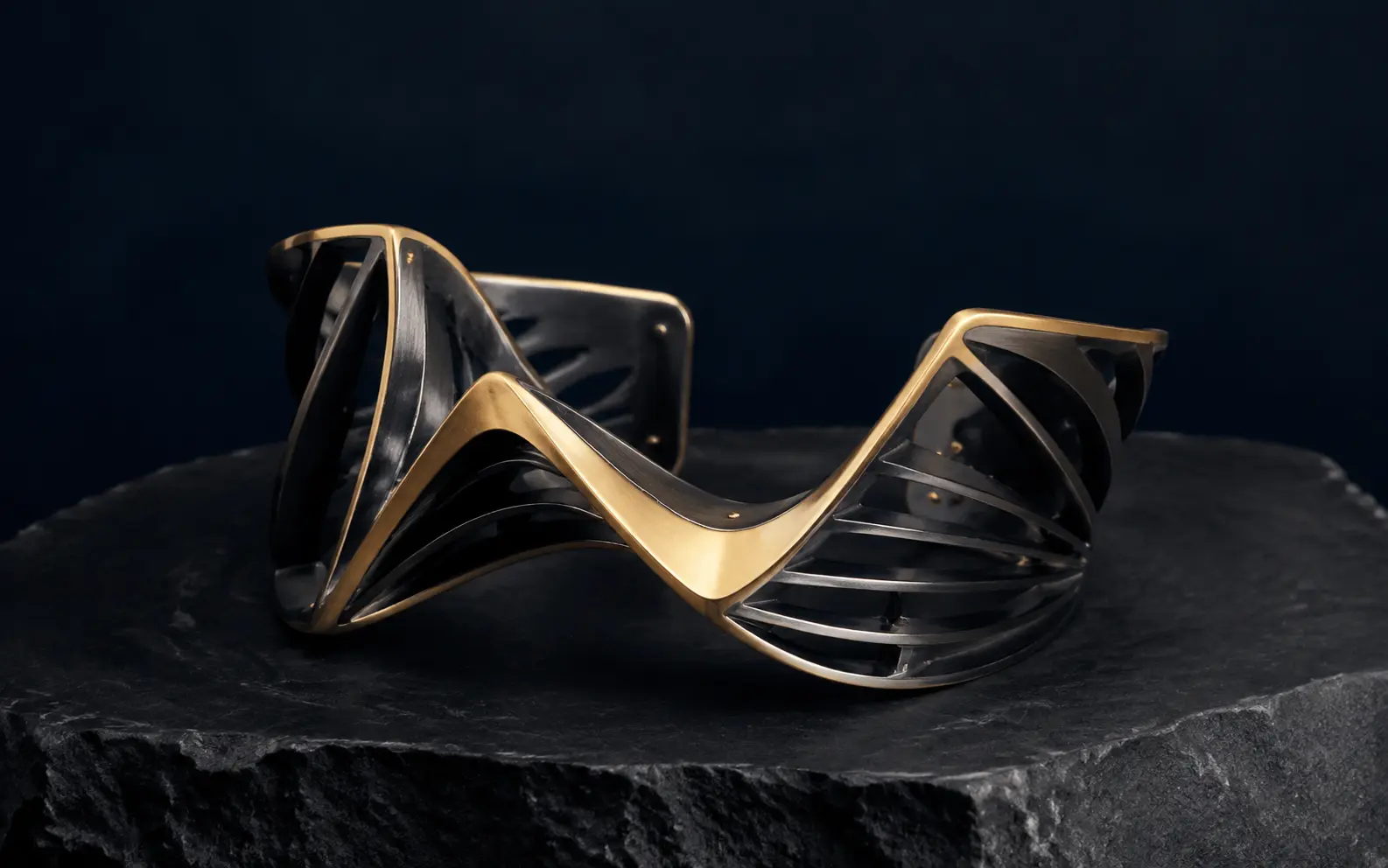
When a celebrated architect enters jewellery, the first attraction is obvious: can the language of a building be carried on a finger, wrist or watch dial? The useful answer is not a miniature building. It is an architectural logic translated into an object that must move with the body.
What transfers from architecture?
Architecture and jewellery both negotiate form, light, material, connection and force. Architects are trained to see part and whole, repetition, rhythm and the movement of attention; all can become powerful at a small scale. Yet scale is not simply a reduction in centimetres. A building displaced by one millimetre may still stand. A ring displaced by one millimetre may not be wearable.
Jewellery rubs against skin, hair, clothing and daily movement. Weight hangs from a small contact point, an edge can cause pain, a closure may need to work with one hand, and a surface must survive polishing and repair. Architectural thinking becomes useful only when it gives up its pride and accepts the body as the primary site.
Zaha Hadid: continuous flow at the scale of a finger
In Zaha Hadid’s Lamellae collaboration with Georg Jensen, the layered forms and flowing lines of her architecture became rings and cuffs. The name points to layers: surfaces curl around the body as bands, designing negative space as deliberately as metal.
WIRED connected the collection to the formal language of projects including Wangjing SOHO. Yet the essential difference was wearability testing. A flawless image still has to fit between fingers, preserve wrist movement and remain tolerable through a day. Translation succeeds not through resemblance alone, but by solving that gap.
The best architectural jewel is not a model of a building. It is a spatial idea that accepts the laws of the body.
Frank Gehry: allowing material to appear unfinished
Frank Gehry’s collaboration with Tiffany & Co., including Fish, Torque and Fold, spoke another language: twists, folds, texture and materials that were not always conventionally polished or precious. Wood, silver and loose sculptural forms suggested that luxury need not be confined to symmetry and immaculate surface.
Gehry’s architecture repeatedly moves between free sketch and rigorous engineering. The same tension appears in jewellery: an object may feel spontaneous, but balance, fastening, hinge and production must be resolved behind it. Formal freedom becomes credible only when the object survives use.
Tadao Ando: the largest change through the smallest move
Tadao Ando’s work with Bvlgari on Serpenti Tubogas changes less of the watch body. Instead, colour and dial material tell stories of seasons and nature. Serpenti’s recognisable geometry remains while stones and tonal shifts bring quietness and changing light into the object.
The approach is close to Ando’s architectural language: control, reduction and sensitivity to light. Its lesson is that a famous collaboration does not need to prove itself by shouting form. Respect for an existing system and one precise intervention may preserve both identities more effectively.
The body is a critic unmoved by fame
The names Zaha Hadid, Frank Gehry or Tadao Ando create attention, but attention cannot replace wearing quality. The body reveals truth quickly: a sharp edge, an unbalanced rotation, a stone that catches, a surface that turns fingerprints into noise. Jewellery on the hand is judged more severely than jewellery in an image.
This matters for emerging designers. Architecture can be a reference, but simply copying a façade or plan usually reduces both disciplines. Ask which principle is transferring: a system of repetition, behaviour of light, structural tension or sequence of movement? Then solve that principle again through metal, skin and manufacture.
Six lessons for jewellery designers
Take the principle, not the shape
Translate a system, rhythm or material behaviour; do not shrink a façade.
Start at real scale
Print or prototype on the body early. A render is silent about comfort.
Design negative space
Skin and air are part of the composition, not accidental background.
Do not hide connection
Clasps, hinges, settings and joints can belong to the design language.
Think with the maker
Digital complexity without casting, assembly and finishing logic is only an image.
Remove the name from the test
If the object fails without a famous credit, it has not yet become a complete jewel.
Frequently asked questions
Did Zaha Hadid design jewellery?
Yes. Her best-known collaborations include Lamellae with Georg Jensen, translating layered, curving architectural language into rings and cuffs.
Which jewellery house worked with Frank Gehry?
He collaborated with Tiffany & Co. on collections including Fish, Torque and Fold, using sculptural forms and unconventional materials.
Is architectural training enough to design jewellery?
No. Form and structural thinking help, but jewellery requires ergonomics, weight, skin contact, closures, setting, manufacturing tolerances and repairability.
Names appear only where they are relevant to the evidence and argument. The essay makes no ranking claim or unverified association and distinguishes official sources, editorial analysis and conceptual imagery.