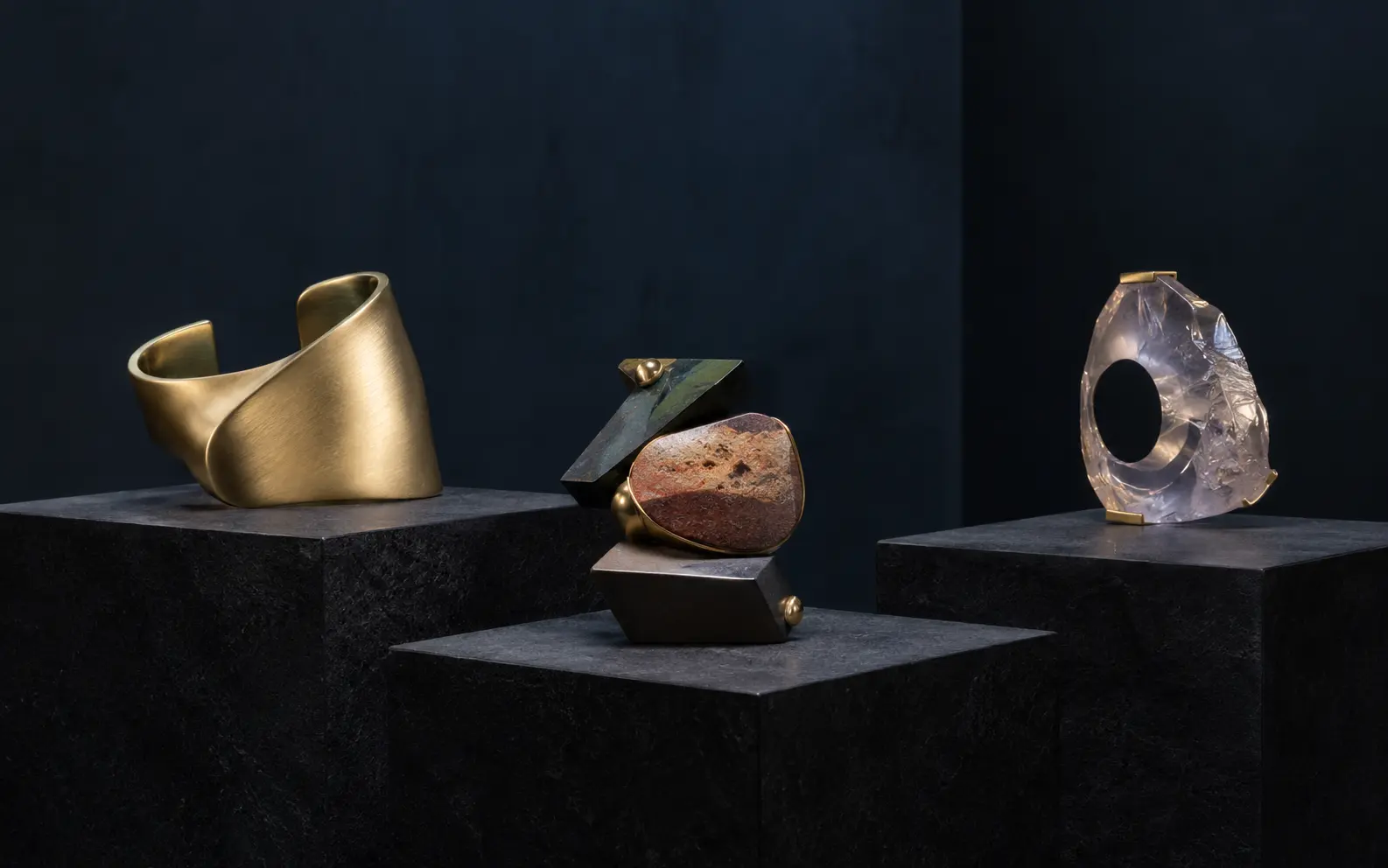
An emerging designer often searches for a signature as a fixed shape: a twist, motif or surface repeated across products. A lasting signature does not come from repeating appearance. It comes from repeating a quality of decision.
What exactly is a design signature?
A signature forms when a set of choices remains recognisable even as subject, material or scale changes. A designer’s relationship to body, curve, colour, connection or the silence between elements persists. The viewer senses the logic before seeing the logo.
This clarity is neither instant nor the product of performative originality. It grows through observation, making, rejection and return. Elsa Peretti, Suzanne Belperron and Wallace Chan show three different starting points: the body, a grammar of form and technical invention.
Elsa Peretti: the body completes the form
Elsa Peretti’s Bone cuff for Tiffany & Co., first designed in 1970, is incomplete without the wrist. Its ridges and recesses answer the bones of the hand, with distinct right and left versions. It looks sculptural in an image, but its identity appears fully through contact and comfort.
Tiffany’s account notes the influence of bones in the Capuchin crypt and the forms of Antoni Gaudí. Peretti transformed those references into a new anatomy rather than applying them as decoration. Her lesson is not to make bones. It is to treat the body as both constraint and collaborator.
If the jewel is removed from the body, how much meaning and function disappears? If the answer is “none,” perhaps the body has not yet been designed.
Suzanne Belperron: “my style is my signature”
Suzanne Belperron often left her jewels unsigned. The line associated with her—“my style is my signature”—expresses confidence in a specific visual language: bold soft volumes, precious gems combined with less conventional hardstones, and colour that ignored traditional hierarchies of value.
Unsigned work is not a virtue by itself; without archives and documentation it can make attribution difficult. Belperron matters because her choices were coherent enough to make a claim of recognition. A contemporary designer need not remove the name, but should build work for which the name is not the only means of identification.
A true signature is not added at the end. It is the decisions that prevented the work from resembling everything else from the beginning.
Wallace Chan: when tools create a new language
Wallace Chan’s career shows that a signature can grow through years of material and technical investigation. The Wallace Cut, titanium mastery, clawless setting and proprietary porcelain are not demonstrations detached from design; they are tools that make other ways of seeing and building possible.
Technical innovation becomes a signature when it serves a consistent visual world. Technique without a problem becomes a trick; form without material knowledge becomes a render. Chan connects the two across a long practice: invention for expression, not invention for a headline.
Body
Form gains identity through contact, movement, weight and comfort.
Grammar
Proportion, volume and colour form a shared logic across different works.
Invention
New tools and materials expand the range of forms that can exist.
Time
None is built in one object. Series, review and continuity are required.
A practice for building signature, not copying style
Do not take the famous designer’s final form; take the type of question. From Peretti: how does the body collaborate? From Belperron: which choice remains yours across ten objects? From Chan: which material limit deserves years of attention?
Define one personal constraint—a connection, proportion, behaviour of light or contact with skin. Build at least ten versions, not ten decorations of one answer. Test each at real scale and record three decisions that recur without forcing. A signature is often not something we invent. After enough work, it is something we discover in our own honest choices.
Choose a problem
Not a motif: a relationship such as balance, protection, movement or memory.
Build a series
Do not decorate one answer; make ten different answers to one question.
Test on the body
Photography, prototypes and extended wear expose different faults.
Archive decisions
Keep rejected forms and reasons. The language appears through those patterns.
Frequently asked questions
What is a jewellery design signature?
It is a coherent set of formal, material and technical choices that makes a designer’s work recognisable even without a logo.
Why were Suzanne Belperron’s jewels often unsigned?
Belperron believed her style was her signature; the strength of her visual language was intended to identify the work without an engraved name.
How can a designer build a signature without copying famous designers?
Study their way of framing problems rather than borrowing final forms. Define a personal constraint, build series, test on the body and document recurring decisions.
Names appear only where they are relevant to the evidence and argument. The essay makes no ranking claim or unverified association and distinguishes official sources, editorial analysis and conceptual imagery.